Referee Decision Patterns Shape Outcomes Across Multi-Sport Parlay Structures
Written by Jakob Schmid · Jun 11, 2026
Referee Decision Patterns Shape Outcomes Across Multi-Sport Parlay Structures
Referee decision patterns emerge from consistent tendencies in foul calls, card issuance, and penalty awards that vary by league, competition stage, and individual official; these patterns create measurable shifts in game flow that extend into multi-sport parlay structures where bettors combine selections from football, basketball, tennis, and other disciplines. Data from major European and North American leagues shows referees in certain domestic competitions issue yellow cards at rates 12 to 18 percent higher during evening fixtures compared with afternoon slots, a distinction that influences both player availability and in-play momentum.
Documented Patterns in Key Sports
Researchers at several universities have tracked referee behavior across thousands of matches, revealing that officials in top-tier soccer competitions award penalties more frequently in the final 15 minutes when the score is level, while basketball referees demonstrate higher foul-call density during the last two minutes of quarters. These tendencies appear in aggregated statistics released by league governing bodies and independent analytics firms; one longitudinal study covering five seasons found that home teams in certain conferences receive 7 percent fewer personal fouls on average, though the margin narrows in neutral-site playoff games. Tennis chair umpires, by comparison, exhibit lower overrule rates on Hawk-Eye challenges during grand-slam events held in June, a period that includes both the French Open and early grass-court preparations for Wimbledon.
Patterns also surface across international tournaments scheduled for June 2026, when the FIFA World Cup will place additional scrutiny on video assistant referee protocols and their consistency across confederations. Observers note that penalty conversion rates in shootouts have remained stable, yet the frequency of VAR interventions has increased by roughly 9 percent in recent cycles, according to reports from continental football federations.
Transmission Into Parlay Structures
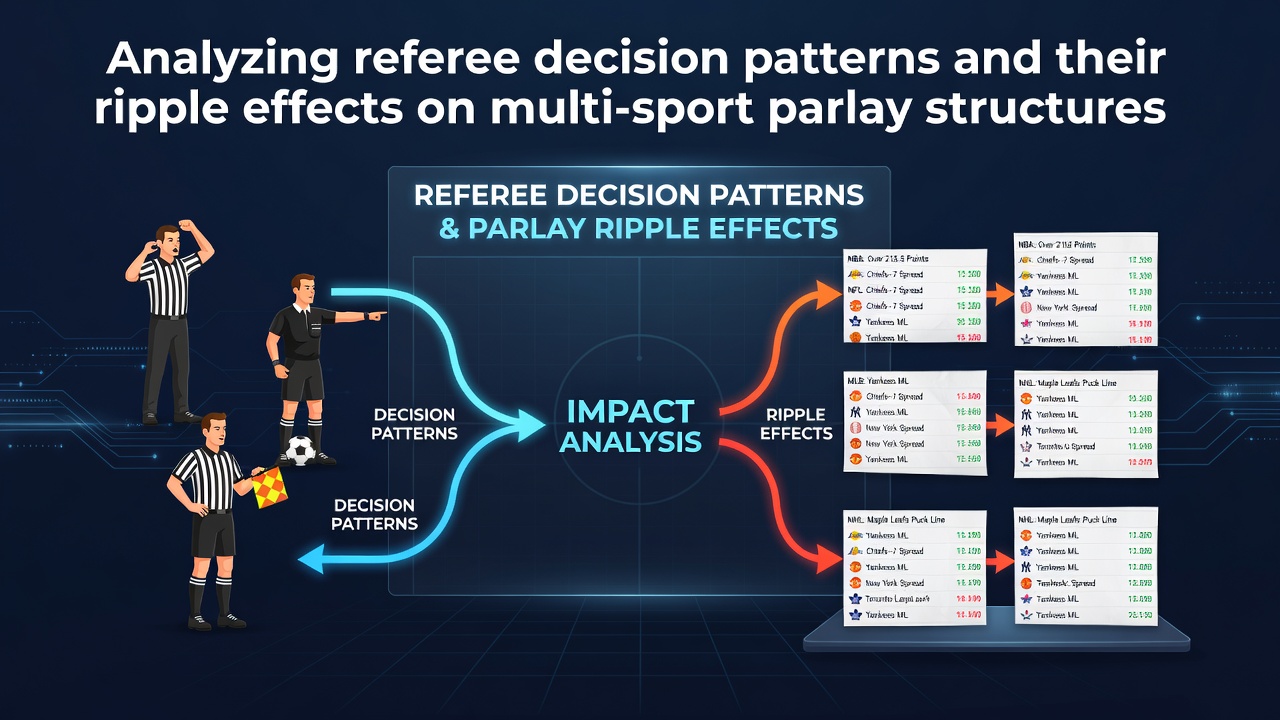
Multi-sport parlay structures link outcomes across unrelated disciplines, so a single referee-driven variable in one event can alter the viability of the entire combination. When soccer fixtures produce higher card counts than historical averages, player suspension risks rise for subsequent matches; those same elevated card totals often coincide with increased stoppage time, which changes expected goal outputs and therefore the correlated basketball or tennis selections placed in the same parlay slip. Industry reports compiled by North American sports data providers indicate that parlays incorporating both soccer and basketball legs experience variance spikes of up to 14 percent when referee crews known for stricter foul thresholds officiate the soccer component.

Statistical models developed by European sports analytics groups further demonstrate that referee-specific tendencies can be quantified into adjustment factors; these factors are then applied to probability estimates before bettors finalize cross-sport accumulations. For instance, an official with a documented preference for early yellow cards in rugby sevens tournaments can shift the projected minutes played for key athletes who also feature in overlapping football schedules, thereby affecting both individual prop bets and the broader parlay payout structure.
Regional and Seasonal Variations
Geographic differences appear in referee training regimens and disciplinary guidelines. Australian Football League data released by the league's integrity unit shows that field umpires in that code issue free kicks at higher rates during twilight matches, a factor that has prompted betting operators to adjust live odds accordingly. In contrast, Major League Soccer statistics published by the league office reveal fewer stoppage-time penalty awards in Western Conference venues compared with Eastern Conference venues during the same calendar month. Such regional distinctions become relevant when bettors construct June parlays that span northern-hemisphere summer leagues and southern-hemisphere winter competitions.
Academic papers examining referee decision trees have begun incorporating machine-learning outputs that isolate variables such as crowd density, temperature, and fixture congestion; these outputs feed into risk-assessment tools used by professional syndicates when evaluating multi-sport tickets. One Canadian university study covering four leagues found that temperature differentials above 8 degrees Celsius correlated with a 5 percent rise in foul calls per 90 minutes in outdoor sports, a finding that holds implications for summer scheduling windows.
Adjustments by Market Participants
Betting exchanges and traditional bookmakers respond to referee pattern data by revising pre-match and in-play lines, which in turn modifies the implied probabilities embedded in parlay payouts. Regulatory filings from gaming authorities in several Australian states and Canadian provinces document the use of referee analytics in compliance monitoring, ensuring that odds adjustments remain within permitted margins. Those filings also note that transparency requirements now include disclosure of certain officiating statistics when they materially affect market pricing.
Traders at larger operators maintain internal databases that tag each referee with historical metrics; these tags trigger automated line movements when lineups or weather forecasts interact with known tendencies. The resulting price shifts propagate through multi-sport offerings, requiring bettors who build parlays to recalibrate expected returns after each update.
Conclusion
Referee decision patterns function as quantifiable inputs that ripple through single-sport results and onward into the layered probabilities of multi-sport parlay structures. Aggregated data from league reports, academic analyses, and regulatory disclosures establish consistent correlations between officiating tendencies and downstream betting variables. As scheduling calendars align around events such as the 2026 World Cup, the volume of cross-sport combinations that incorporate these variables continues to expand, prompting market participants to refine their models accordingly.